
Beauty Guides
Cavitation Results: Timeline & How to Get the Best Results — Practical Guide
A practical guide to cavitation Results: Timeline & How to Get the Best Results. Compare the key concepts, product formats and points to check before choosing.
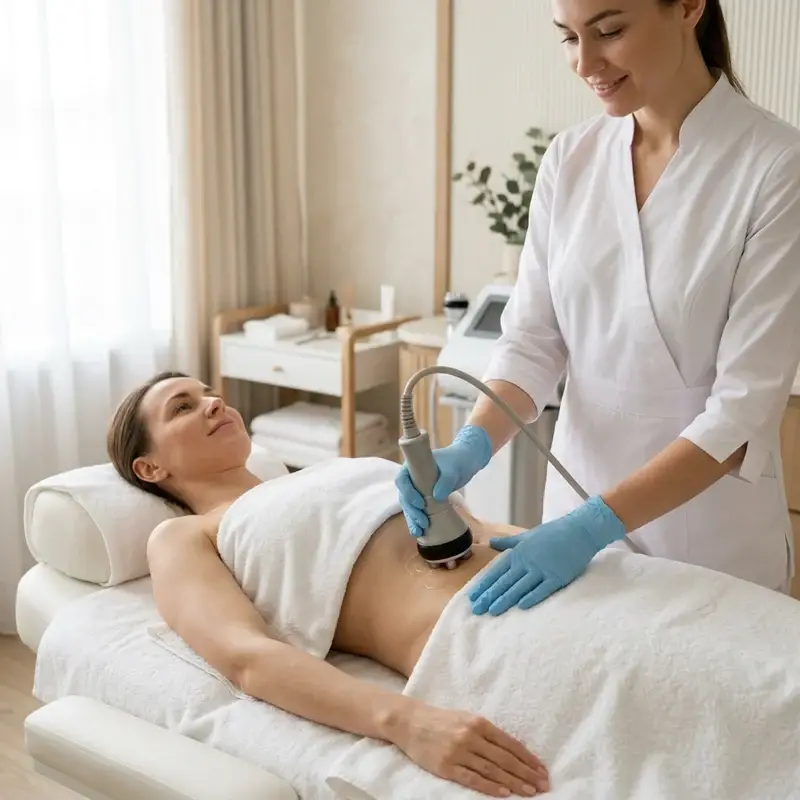
Quick answer: Most people notice subtle early changes after 2–4 cavitation sessions, but the results worth photographing arrive 6–12 weeks after starting a full course of 6–12 sessions. A peer-reviewed review found the typical outcome is a 2–4.6 cm reduction in abdominal circumference — real, but modest, and it contours rather than causes weight loss.[1] How much of that you actually see depends heavily on hydration, activity and consistency between sessions.
The gap between "session done" and "results visible" is where most confusion — and most dropped-off clients — come from. Once you understand why that gap exists, the whole treatment makes much more sense.
Why Results Take Time: What Cavitation Actually Does
Ultrasonic cavitation uses low-frequency sound waves to create microscopic bubbles in the fluid around fat cells. The bubbles collapse, and the pressure wave disrupts the fat cell membrane. The contents are then released as glycerol and free fatty acids, which your lymphatic system has to transport to the liver for processing and elimination.[1][3]
Critically, the device does not remove fat — it breaks it down and hands the clearance job to your body. Lymphatic clearance does not happen overnight, which is exactly why results build gradually instead of appearing the moment you step off the table.
For a full explanation of the mechanism, see Ultrasonic Cavitation: How It Works.
Cavitation Results Timeline, Stage by Stage
Why your best result isn't on your last session day. Your body keeps processing released fat for weeks after treatment ends. If your machine also delivers radiofrequency, collagen remodelling often peaks around 4–8 weeks and visibly improves firmness for several months. This is why experienced clinics photograph "after" at the 8–12 week mark rather than the day after the course.[4][6]
What Realistic Cavitation Results Actually Look Like
This is the part most competing articles skip. Here is what the evidence supports
Circumference reduction: 2–4.6 cm in the treated area across a full course, per a dermatology review covering 231 studies.[1] Clinic-side reporting converges on a similar 2–4 cm range for good candidates completing 6–10 sessions.[5]
It is not weight loss. Controlled research found that adding ultrasound + RF body contouring to a low-calorie diet produced measurable reductions in fat mass versus diet alone, even when total body weight barely differed between groups.[7] Cavitation changes composition and shape, not the number on the scale.
It suits certain bodies best. Results are most consistent for people already near their target weight working on soft, pinchable deposits — generally at least a 2 cm skinfold.[5] Very firm or fibrous fat responds less predictably.
If skin laxity is your main concern, cavitation alone gives limited tightening. Ask about combining it with radiofrequency. Machines built around that combination, such as the Home-use 30K with RF Skin Tightening ($278.00), target both concerns in one course.
How to Track Before & After Properly
Circumference change of 2–4 cm is easy to miss in a mirror and easy to over-claim in a photo. To get an honest read
Measure, don't guess. Use a soft tape at the same landmark each time — mark it if needed. Measure the same 3–4 points around the treated area.
Control the conditions. Measure at the same time of day (morning is most consistent), before eating, using the same tape tension.
Take photos consistently. Same room, same lighting, same distance, same pose, same time of day. Varied lighting and flattering angles account for a large share of the dramatic "before and after" images circulating online.[5]
Take your final photos at 8–12 weeks, not at the end of your last session.[4]
Keep a session log noting date, area and hydration — this makes it obvious which variables correlate with better clearance for you.
How to Get the Best Results: 11 Evidence-Aligned Habits
These are the behaviours that most affect how much of the treatment's fat-disruption benefit converts into visible inch loss.
1. Drink plenty of water before and after
The lymphatic system needs fluid to transport and eliminate the released fatty material. Sufficient intake is the single most impactful habit — most protocols recommend extra water on the session day and for the following 24–72 hours.[4][5]
Light exercise after treatment accelerates clearance through the lymph nodes. Walking is sufficient; you do not need intense training.
Avoid eating for around two hours before and after treatment, and eat within roughly four hours of the procedure.
A balanced, lower-calorie diet supports clearance and helps maintain results. Cavitation aids fat reduction; it does not replace sensible eating.
5. Choose an effective cavitation machine
Machine quality and configuration measurably affect the outcome. Poorly powered devices simply take longer to produce visible change.
6. Consider RF alongside cavitation
Applying radiofrequency before or after cavitation increases blood flow and cell activity in the target area, supporting clearance and firmness.
7. Respect the interval between treatments
Cavitation produces its best results at roughly 1–2 sessions per week, giving the body adequate time to clear what was released.[2]
Maintenance treatments are advised for most body types — commonly spacing the first sessions about a month apart, then tapering as your contour stabilises.
Massaging supports removal of destroyed fat cells and improves local circulation.
High stress levels affect how your body responds to treatment. Meditation, yoga or similar practices support the outcome.
11. Keep realistic expectations
Body cavitation is a complement to a good diet and exercise — not a substitute for either.
What to Avoid Between Sessions
Alcohol — skip it for 2–3 days after treatment; it competes with the liver's ability to process the released fatty acids.
Caffeine — avoid for 3–4 days before and 48 hours after treatment.
No food 2 hours before and 1 hour after each session.
Anti-inflammatories (ibuprofen, aspirin) — avoid for two days before and after treatment.
Dry skin brushing daily to promote lymphatic drainage.
No hot shower, spa or sauna right after treatment; warm showers are fine.
Wait Before Starting If You Have
Recent surgery or scars — wait 6 months
Active skin disease, infections, varicose veins, metal contraceptive coil or silicone implants in the area
A current course of antibiotics — wait until completed
Not yet finished your menstrual period
Recently used depilatory creams — wait 2 weeks
Recent IPL or laser — wait 2 weeks
Botox in the target area — wait 3 months
Dermal fillers in the target area — wait 2 weeks
Recent suntan — avoid tanning during your course
Consult a qualified professional and disclose your full medical history before beginning any course.
Cavitation suits parts of the body with localised fat — the abdomen, arms, thighs and buttocks are the most appropriate.[5] Smaller zones such as the chin require a smaller handpiece.
Machines That Support Better Results
Consistent sessions are hard to maintain if you rely solely on clinic appointments. Owning a machine makes it easy to follow the recommended 1–2 sessions per week.
Plus the essential consumable: 300g Ultrasound Gel ($16.99) — gel is required for efficient transmission of the ultrasound energy.
→ Shop all cavitation machines
Cost context: at typical US clinic pricing of $150–$350 per session, a full 6–12 session course runs roughly $1,000–$1,800.[8][9] A home machine costs less than a single professional course.
Subtle changes often show after sessions 2–4, measurable circumference reduction typically from session 4–6, and visible contour change from sessions 6–10. Your best result appears 6–12 weeks after starting.[4][5]
How many sessions before visible results?
A full course spans 6–12 sessions, most commonly 8–10, spaced 1–2 times per week with at least 48 hours between.[2]
Research supports a 2–4.6 cm reduction in abdominal circumference across a full course;[1] clinic reporting converges around 2–4 cm for good candidates.[5]
Are cavitation results permanent?
Destroyed fat cells do not regenerate. However, remaining fat cells can expand if you gain weight, so maintaining stable diet and activity protects your result.[5]
Your body continues metabolising and eliminating the released fat for roughly 2–3 weeks after the course ends, with collagen remodelling continuing longer if RF was used.[4]
Does cavitation cause weight loss?
Not meaningfully. It reduces circumference and improves contour; studies show fat-mass changes while body weight stays similar.[7]
Hydration is the highest-impact habit, followed by light exercise, avoiding alcohol, respecting session spacing, and supporting lymphatic drainage.[4][5]
Most people benefit from maintenance to sustain results, with tapering frequency once your contour stabilises. Top-up sessions once or twice a year suit those prone to re-accumulation.[2]
Getting the best cavitation results is less about a single dramatic session and more about consistency plus lymphatic support. Expect 2–4.6 cm of circumference reduction over a 6–12 session course, judge your outcome honestly at the 8–12 week mark using consistent measurements, and support your body with hydration, activity and correct spacing. Those who treat cavitation as a complement to a healthy lifestyle are consistently the most satisfied with the outcome.
Ultrasonic Cavitation: How It Works & What It Really Does
The Side Effects of Ultrasonic Cavitation
30K vs 40K vs 80K Cavitation Machines
How to Choose a Cavitation Machine: Home vs Professional
Everything You Need to Know About Cavitation Gel
A Review of the Use of Ultrasound for Skin Tightening, Body Contouring, and Cellulite Reduction in Dermatology — PubMed PMID 29846343 (231 studies; 2–4.6 cm abdominal circumference reduction). pubmed.ncbi.nlm.nih.gov/29846343 (accessed 31 Oct 2026)
Neocure, Ultrasonic Cavitation (Lipocavitation) — technical review verified 23 Mar 2026 (spacing, session counts, maintenance). neocure.eu
Bani D, et al. Histological and Ultrastructural Effects of Ultrasound-induced Cavitation on Human Skin Adipose Tissue — PubMed PMID 25289235. pubmed.ncbi.nlm.nih.gov/25289235
OJAN Beauty, How Long Does It Take to See Results from Ultrasonic Cavitation? (stage timeline, 8–12 week photos, RF collagen remodelling). ojanbeauty.com
Salon Searcher, Ultrasound Cavitation Before and After (stage 1–3 / 4–6 / 7–10, 2–4 cm, 2 cm skinfold rule, long-term maintenance). salonsearcher.co.uk
OJAN Beauty, Cavitation Treatment Guide 2026 (1–2 sessions per week, 6–10 session courses). ojanbeauty.com
Controlled study of low-calorie diet plus ultrasound/RF body contouring showing fat-mass reduction with body weight largely unchanged, as reviewed by OJAN Beauty 2026 (citing PubMed 2019). ojanbeauty.com
MedSpa Directory, Cavitation vs Coolsculpting 2026 (US per-session pricing). medspadirectory.skin
eathealthy365, How Much Does Ultrasonic Cavitation Cost? (2026 US price tiers and packages). eathealthy365.com
Note: machine prices verified from product-page structured data on 31 October 2026 and are subject to change. Confirm current pricing on each product page.
Disclaimer: General education, not medical advice. If you experience unexpected or persistent symptoms, stop treatment and consult a qualified healthcare professional.
Questions & discussion