
Beauty Guides
What Is Hydro Dermabrasion? Benefits Process and Suitability — Practical Guide
A practical guide to what Is Hydro Dermabrasion? Benefits Process and Suitability. Compare the key concepts, product formats and points to check before choosing.
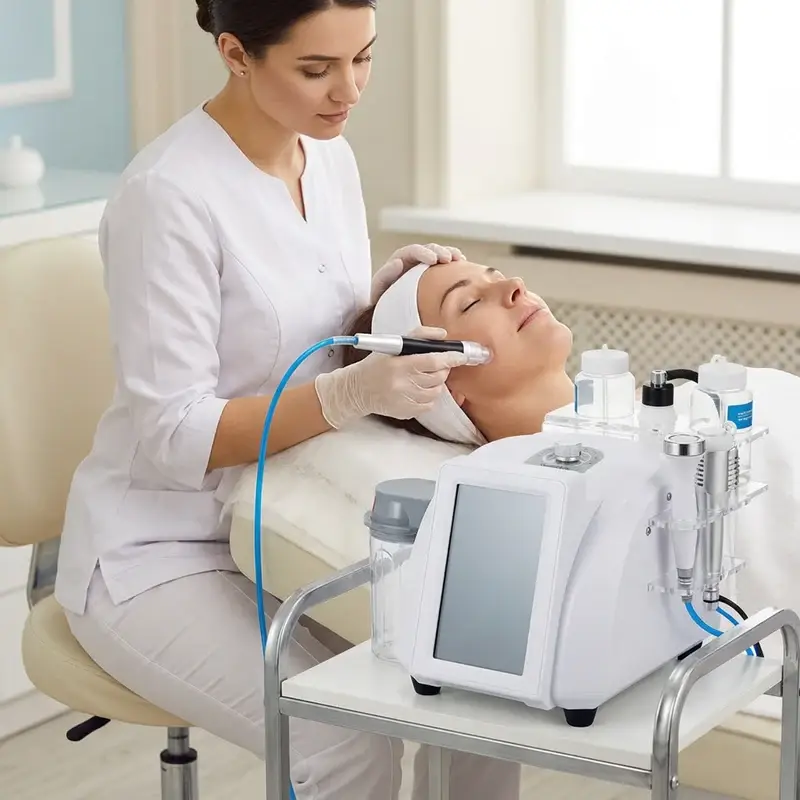
What Is Hydro Dermabrasion — and Is It the Same as a HydraFacial®?
Hydro dermabrasion (also written hydradermabrasion, and sometimes called a "hydro facial" or "aqua peel") is a generic technique category: under negative pressure and a fluid stream it lifts off the outermost keratinocytes and debris while simultaneously delivering a water-based solution or serum (PMC: PMC4155739; Freedman 2008, PMID: 19146604, DOI: 10.1111/j.1473-2165.2008.00406.x). The single defining difference from dry microdermabrasion is that exfoliation and hydration happen together — resurface while you hydrate — rather than as two separate steps (PMC: PMC4155739).
That distinction matters before you buy: a category-named machine is not automatically compatible with a brand's proprietary consumables. For a detailed side-by-side comparison of the two exfoliation styles, see the hydradermabrasion vs microdermabrasion guide.
How Does Hydro Dermabrasion Work, Step by Step?
Mechanically it is a staged loop of cleansing, resurfacing, suction-assisted clearing and solution delivery — not a single "jet". Published descriptions emphasise that one pass combines a solution with suction-assisted exfoliation (PMC: PMC4155739; Freedman 2008, PMID: 19146604, DOI: 10.1111/j.1473-2165.2008.00406.x).
Tip geometry, pressure, pass count and solution composition are device- and operator-dependent, so refer to the product page / user manual for any specific machine. How many functions a vendor integrates is a purchasing question, not a proven difference in outcome.
What Results Can It Realistically Deliver — and What Can't It?
Small studies report improvements in fine lines, pore appearance, skin tone and measured skin thickness, but the samples are tiny, the changes are temporary, and results vary widely between individuals. The table below separates what has been observed from the limits that must travel with each claim.
In plain terms: expect a temporary, subtle improvement in surface smoothness and hydration. You cannot responsibly claim it clears acne, removes wrinkles for good, or replaces a surgical procedure. Any protocol promising a fixed number of sessions to a defined result overstates the evidence.
Who Is a Good Candidate — and Who Should Wait?
A good candidate is an adult with intact, non-inflamed skin, mild surface dullness or congestion and realistic expectations; a long list of conditions should prompt postponement and a professional evaluation first. "Gentle" is not the same as "appropriate for everyone".
The AAD states that pregnancy safety data are lacking and that decisions in pregnancy belong with a dermatologist or obstetric clinician (AAD, Is any acne treatment safe to use during pregnancy?). Sensitive or reactive skin needs a patch test and an operator assessment rather than a blanket reassurance, and darker skin tones warrant professional evaluation because dyspigmentation risk is documented in peel guidance (AAD, Chemical peels: FAQs; AAD, How to fade dark spots in darker skin tones). For the full contraindication list, see hydro dermabrasion side effects and who should avoid it.
What Side Effects and Downtime Should You Expect?
Most reactions are transient and mild, but the timeline is graded by intensity rather than a single short window. Common, expected effects are brief pinkness, a feeling of tightness and slight oedema. For microdermabrasion, the AAD records that transient pinkness or slight swelling usually settles within about one day (AAD, Microdermabrasion: FAQs). For hydro dermabrasion specifically, the 8-subject imaging study observed erythema resolving over 2–5 days after light-to-moderate treatment (Razi 2024, DOI: 10.1111/srt.13684, PMC: PMC10983707). A light pass may leave redness that fades quickly, while a more intensive pass can produce visible erythema lasting several days.
How Often Should You Get a Hydro Dermabrasion Treatment?
There is no single universal schedule; a common professional plan is 4–6 sessions spaced 2–4 weeks apart, adjusted to skin type, response and the operator's assessment. Research protocols are context, not consumer rules: the Freedman study used 6 sessions at 7–10 day intervals (Freedman 2008, PMID: 19146604, DOI: 10.1111/j.1473-2165.2008.00406.x), while the AAD describes microdermabrasion as 5–16 sessions at weekly to monthly intervals (AAD, Microdermabrasion: FAQs). These figures come from different techniques and small studies, not a promise of a defined result; treat any fixed session count with caution.
What Does Aftercare Actually Involve?
Aftercare is deliberately conservative: protect the barrier and avoid adding irritation while the surface settles. The AAD advises moisturising and sun protection after exfoliating treatments (AAD, Microdermabrasion: FAQs).
Use a gentle cleanser and a bland moisturiser; keep the skin hydrated (AAD, Microdermabrasion: FAQs).
Apply a broad-spectrum SPF 30 or higher and reapply at least every 2 hours when exposed; tinted sunscreen containing iron oxides can help prevent and fade dark spots in deeper skin tones (AAD, How to fade dark spots in darker skin tones; AAD, Chemical peels: FAQs).
Avoid sun exposure, tanning beds, picking and scrubbing the treated area.
Pause potentially irritating actives — retinoids, acids and exfoliants — based on your pre-treatment assessment rather than following a fixed hour count (AAD, Microdermabrasion: FAQs).
Follow the operator's instructions and the device user manual; contact a professional for burning, itching or worsening swelling.
Makeup timing and the resumption of actives should follow the written aftercare guidance you provide, not an assumption of an unrestricted return to normal routine.
Is It Regulated, and What Does the Label Mean?
At-Home vs Professional: How to Choose a Device
Choose by function mix and setting, not by a claim of superior results. Professional and at-home devices differ in who operates them, the training required and the feature set — not in a verified hierarchy of outcomes. Match the machine to the scenario: a compact multi-function unit for a small treatment room or supervised personal use, a standing system for a busy salon, and AI skin-analysis or LED-mask variants only where those functions will actually be used.
All prices are as listed on the product page, subject to change. Specifications such as suction, tip count, frequency, certification, warranty and shipping are not stated here — refer to the product page / user manual. AS1/SA2/AO3 are the three-bottle solution set sold on this site; compatible with hydro dermabrasion machines. Compare current models in the hydro dermabrasion machine collection. Rank machines by function combination, footprint and consumable availability, not by a promised outcome; be cautious of any listing promising a fixed, lasting result, because the evidence above does not support it.
Is hydro dermabrasion safe for sensitive skin?
Not automatically — sensitive or reactive skin needs an assessment first. Active rosacea, a changing lesion or a solution allergy are reasons to postpone (AAD, Microdermabrasion: FAQs; AAD, Chemical peels: FAQs). Disclose any allergy to the solutions used and ask for a patch test.
How long do hydro dermabrasion results last?
Most people report a cooling, suction-like sensation rather than pain, but comfort varies with intensity and the operator (Razi 2024, DOI: 10.1111/srt.13684, PMC: PMC10983707; AAD, Microdermabrasion: FAQs). Report burning or increasing discomfort during the session.
Follow your operator's timing rather than assuming an immediate, unrestricted return to normal routine. Aftercare prioritises gentle cleansing, moisturising and SPF 30 or higher while the surface settles (AAD, Microdermabrasion: FAQs; AAD, Chemical peels: FAQs).
How often should you get hydro dermabrasion?
A common plan is 4–6 sessions spaced 2–4 weeks apart, adjusted to your skin and the operator's assessment (AAD, Microdermabrasion: FAQs; Freedman 2008, PMID: 19146604, DOI: 10.1111/j.1473-2165.2008.00406.x). Research intervals of 7–10 days describe a study protocol, not a universal rule.
This page is the canonical pillar overview for the Hydro Dermabrasion cluster
What hydro dermabrasion treats: acne, fine lines and dark spots
Hydradermabrasion vs microdermabrasion: which is right for your skin?
Hydro dermabrasion side effects and who should avoid it
Compare current models in the hydro dermabrasion machine collection
Questions & discussion